

“This second release with Warlock Audio reflects that growth and feels like a natural continuation and step forward in my development as an artist.”
Warlock boss, Soul Chemical, sits down with alias to discuss his latest release on the label, some technical details that went into making the tracks, and what the artist has planned for the upcoming year.

For those who may be discovering you for the first time, how would you describe yourself as an artist, and how did this project originally take shape for you?
Artist Background
I’m a drum and bass artist that leans towards the Neurofunk side of the scene. I’m always trying to find a balance between dark, heavy, aggressive sounds and real emotional weight. My goal as an artist is for my music to create a sense of awe. Whether that feeling comes from sheer intensity or from a deeper, more emotional place, it doesn’t really matter to me, as long as it hits in a meaningful way. This whole project came about from the desire to do just that.
How has your sound evolved over the years, especially within the Neuro-Dancefloor space? Do you feel like you’re refining a vision or still actively reshaping it?
The dark and heavy yet emotional sound that I’m working on has taken shape as I’ve spent more time developing my production. Each track I release helps me understand and refine my own sound a bit more and this project is no different, feeling like another step towards the vision of myself as an artist that I have in my head.
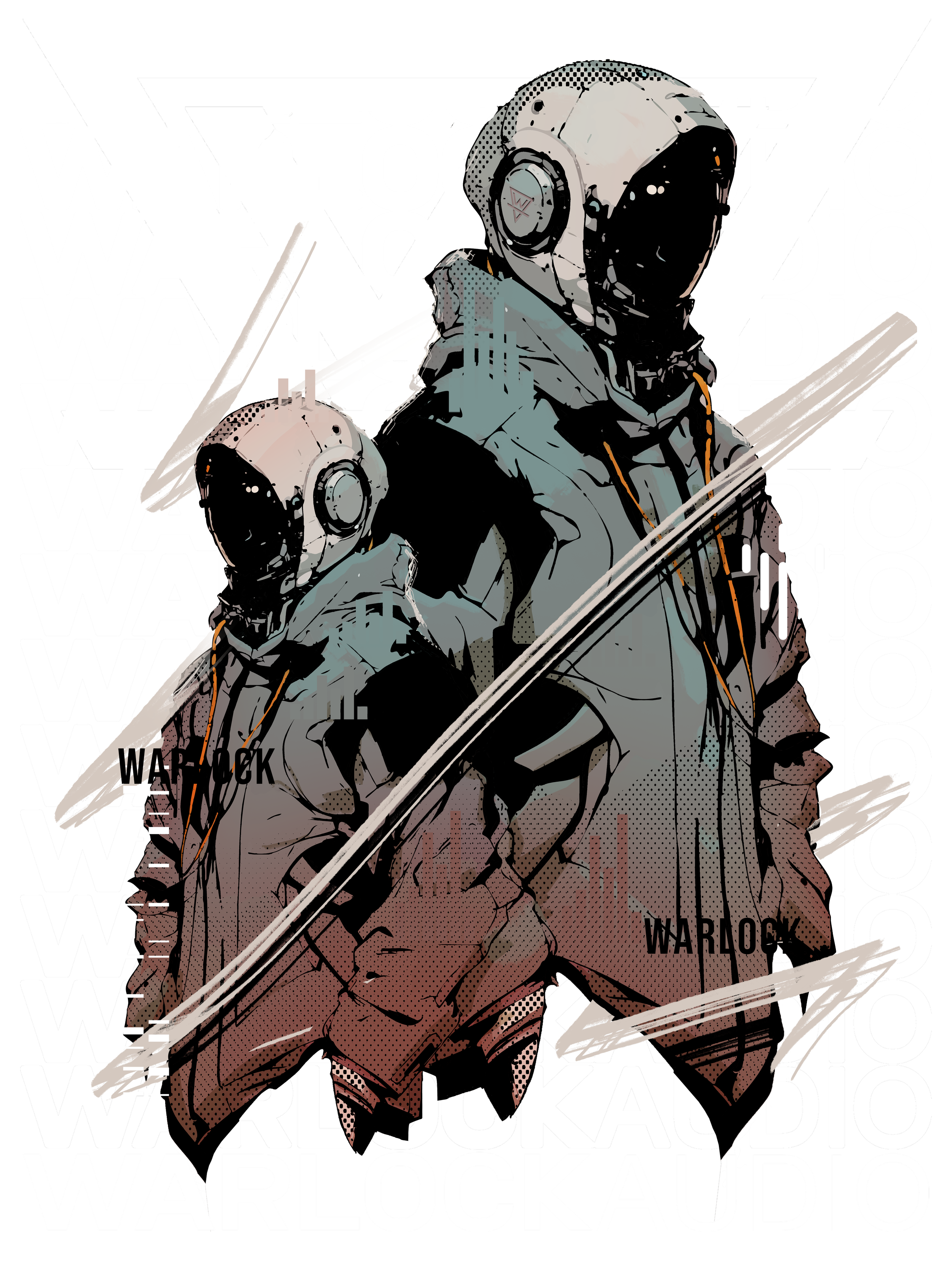
Grab this amazing background art on a T-shirt here
Which producers or artists have had the biggest influence on your music, either stylistically or philosophically? What is it about their work that resonates with you?
Camo and Krooked by far, they gave me that initial drive/inspiration to make music and they have had the largest impact on my journey as an artist so far. The emotion that they can convey in their tracks, and the sheer quality of their production consistently blows my mind. The thought that I could possibly evoke in someone else the emotions their music evokes in me is one of the main things that drives me to make music. My recent sound however has been somewhat shaped and influenced by the likes of Burr Oak, Eluun, and Synergy.
The Release
This marks your second release on Warlock Audio. What does returning to the label mean to you, and how does this release differ from your first appearance?
For me, my return to the label represents a sense of momentum and a drive to learn, iterate, and improve both my production and songwriting. Since my first release, I’ve gained a much clearer understanding of my sound and creative process. This second release with Warlock Audio reflects that growth and feels like a natural continuation and step forward in my development as an artist.
First release here:
When you started these tracks, did you have a clear emotional narrative in mind, or did the mood reveal itself as the production developed?
Both tracks were started with a rough emotional concept in mind but there was nothing fully formed or defined from the beginning. In my production, I find that leaving space for a track to evolve on its own is far better than laying down too many guardrails early on. As the production developed, the moods of the tracks revealed themselves naturally and I followed that rather than forcing them towards any specific goal.
Neuro-Dancefloor often walks a line between aggression and accessibility. How did you balance raw emotional weight with dancefloor impact on this release?
To balance that line, I tried to allow the more emotional elements like pads, plucks, arps and strings to first set the tone and atmosphere of the track, and then contrast that with heavy basses and tight, snappy drums. I think this creates a polarity that keeps the track emotionally engaging while also being hard hitting on the dancefloor.
Sound Design & Technical Approach
Let’s get technical: how did you approach the sound design for these tracks, particularly the basses? Were you chasing a specific texture or feeling from the outset? Can you give us a breakdown of one of the patches used?
For the main chorus bass in Demons, my decision-making regarding the sound design was influenced by two main goals:
1. I wanted a heavy sustain bass that single-handedly carried most of the weight of the chorus.
2. I wanted a bass with sufficient melodic and harmonic qualities so that it didn’t feel flat.
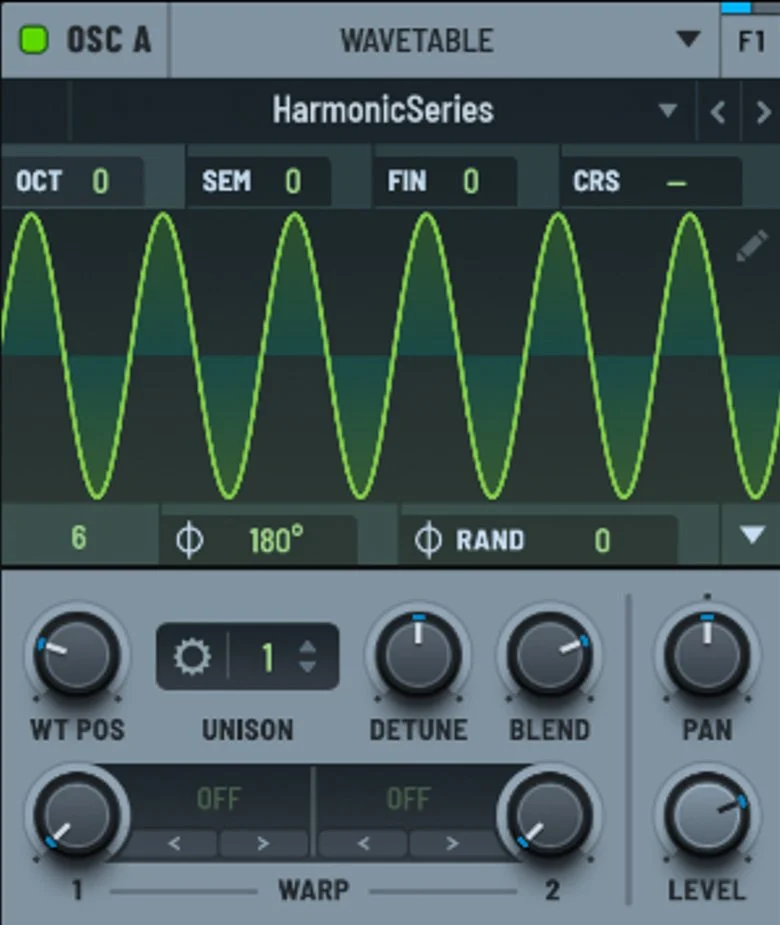
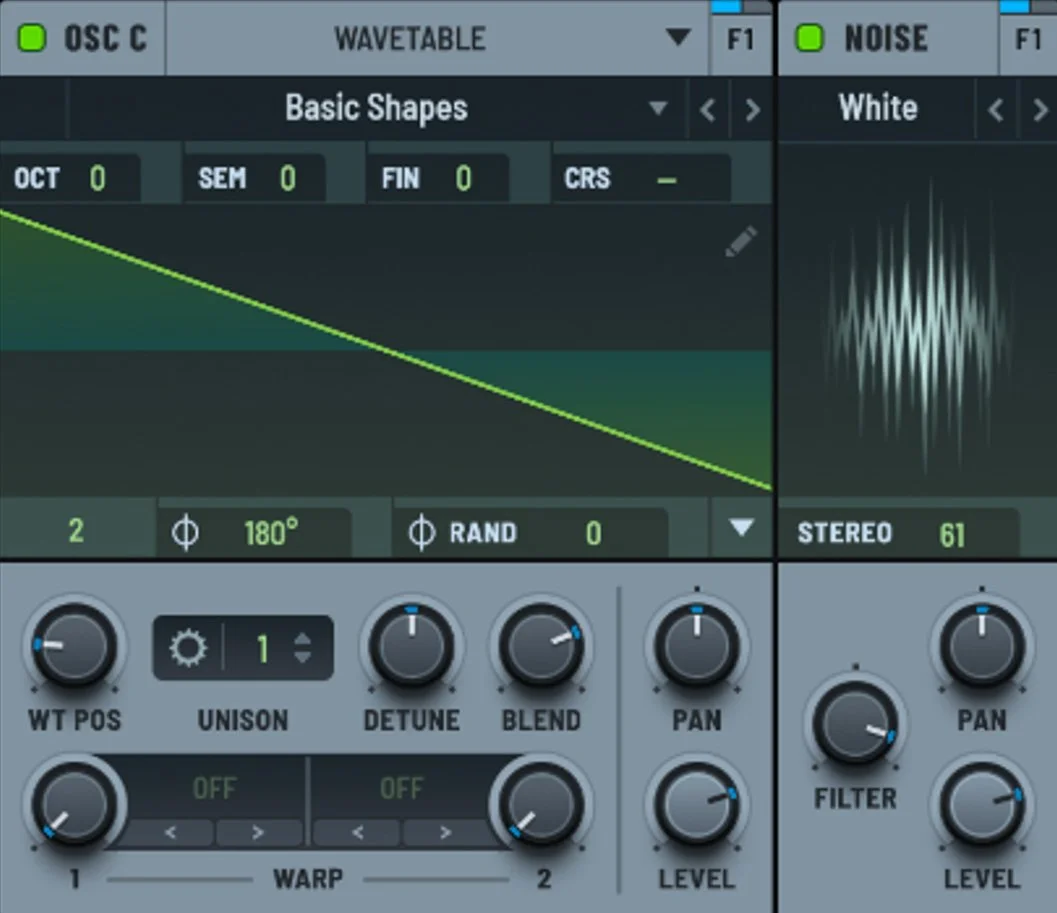
Based on these two factors, I used Serum 2’s three main oscillators to produce, on oscillator A: a root note, on oscillator B: a major third note (+4 semitones), and on oscillator C: a perfect fifth note (+7 semitones). Both the major third and perfect fifth are played two octaves above the root, effectively creating a major chord.
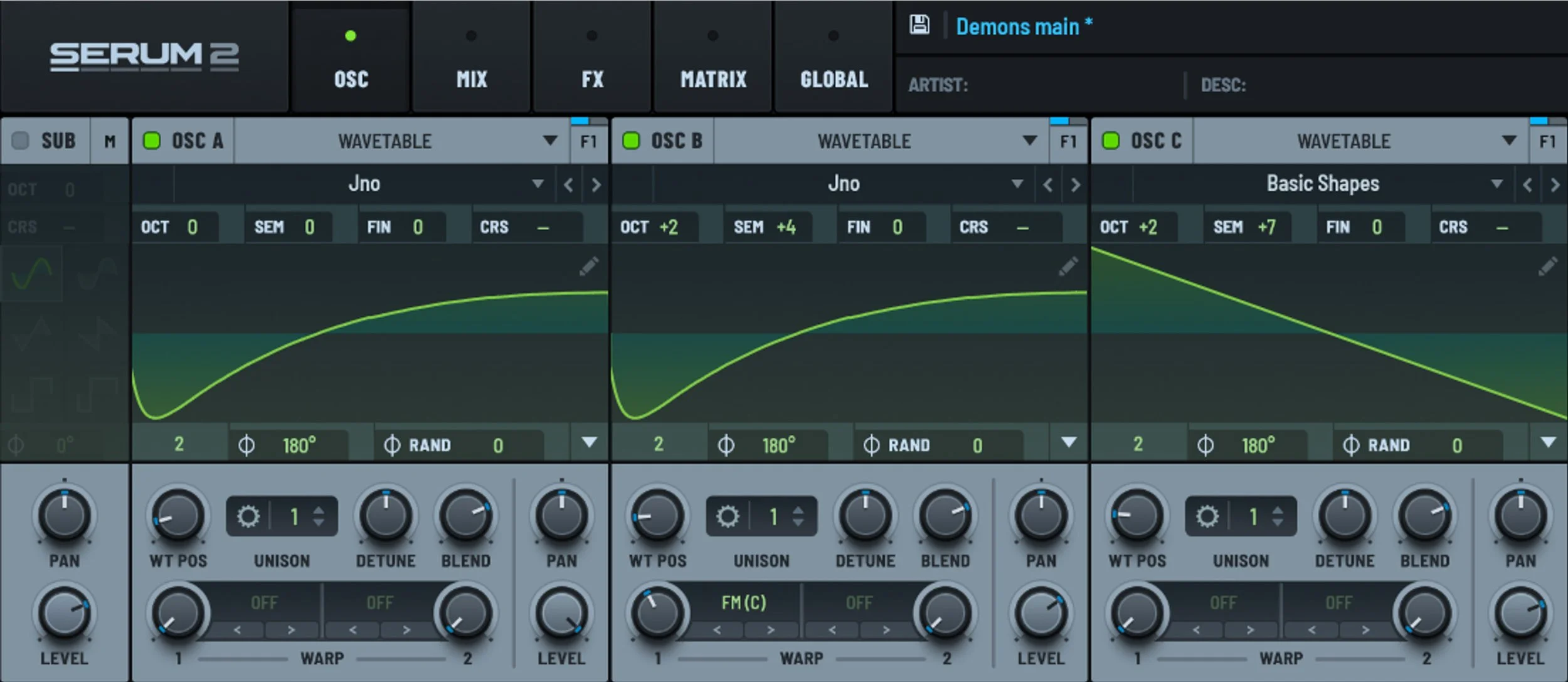
Most of the tone of this bass comes from Oscillator C modulating the frequency of oscillator B. Crucially, however, this is true frequency modulation rather than phase distortion which is how FM was performed in Serum 1. In addition to this the noise oscillator is playing white noise, and the master tuning of the entire Serum patch is being modulated with an LFO to give the bass a vibrato effect that adds movement and prevents it from feeling static.
All of this is then routed through heavy distortion, some multiband compression and light chorus inside of Serum. The post-processing simply involves some OTT, light reverb and EQ.
As with nearly all my bass sounds, I used multiple layers to achieve a full and balanced sound. In addition to the main Serum patch, there is a low-mid harmonic layer consisting of a harmonic series wave playing the sixth harmonic of the fundamental that helps to glue the entire sound together. There is also a noise layer made from white noise and a saw wave that are being driven into distortion and high passed to create a rattle-like texture that helps fill out the top end of the spectrum.
Are there any standout elements like bass patches, leads, or atmospheres that took an unusual amount of experimentation or problem-solving to get right?
The main synth chords in the chorus of Paradise just would not sit right in the mix for some reason and I spent far longer than I’d like to admit tweaking the stereo image, adding dynamic EQ bands, and doing general equalisation work to get it sounding right. The solution ended up mostly lying in controlling the space around the sound, rather than changing the sound itself.
How do you typically structure your sessions when working on tracks like these? Do you separate sound design, arrangement, and polish, or is it more fluid?
I normally start tracks with bass sound design closely followed by drum synthesis/sample selection along with drum programming. After I’ve got a basic idea for those two things down, I’m very fluid in my workflow. I’ll often jump around the project, working on different aspects of the track almost in parallel, adding things as ideas come to me. This fluidity allows me to stay flexible in where I put my creative energy, which helps keep me from overthinking any specific element or stage too much.
Can you talk a bit about your bus processing and group workflow? How much of the weight and cohesion comes from individual sounds versus group processing?
My projects are split into anywhere from 4 to around 8 main groups: Drums, Bass, Vocals, FX, Atmosphere, and then any other melodic elements like Orchestral, Plucks, Synth Chords or Choir Voices. The main drum group is then further divided into Kick, Build Kick (kick roll), Snare, and Tops. The main Bass group is divided into a Sub Bass group and a Non-Sub Bass group, with the Non-Sub Bass group containing all of the basses in the song but with their fundamental and often second and third harmonics removed (this doesn’t apply to reese basses which retain their sub frequencies). This separate treatment of the sub frequencies allows for very precise control over their consistency and specifically aids in the elimination of ‘bowtie-ing’ when sidechaining.
Non-bowtie:

Bowtie:

With regards to weight and cohesion, the drums get most of this from individual sample processing, using transient shaping, EQ, saturation and distortion. Very little group processing is applied aside from subtle saturation and clipping. I use a similar approach with the bass groups which gain nearly all their weight from processing done inside of Serum and some post processing on the individual tracks. The only significant group processing done to any of the basses is EQ and clipping.
Mastering Process
You mastered these tracks yourself, and they sound exceptionally polished. At what point do you decide a track is ready to move from mixdown into mastering mode?
I am normally very fluid with my mixdown process and often mix a track as I produce it, which blurs the edges of when the mixdown process starts and ends. However, mastering comes about when:
- I am happy with a song structurally and conceptually.
- I have no, or very few (normally less than 3) identifiable issues with the mix (the mix can always be endlessly tweaked, so a line has to be drawn somewhere).
- The song has good translation across multiple different speakers and with headphones.
Can you walk us through your mastering chain in detail; EQ, compression, saturation, limiting, and what you’re listening for at each stage?
1. EQ: Deliberate but small boosts and cuts to subtly shape the tonal balance. A low-cut on the side signal somewhere around 100hz to negate any phase issues with the sub frequencies when listening in mono, and subtle shaping of the side signal in the remaining unaffected area above the low cut.
During this step I am listening for areas (not individual elements) in the mix that are slightly too busy or that stick out of the mix in an unintentional and undesirable way. On the contrary I am also listening for areas in the mix that are not as pronounced or apparent as I would like them to be. Using a gain matched reference track that has the desired sound helps massively to achieve the intended tonal balance and side image.
A key thing to bear in mind is that EQ at this stage should not be used with the intention of affecting individual elements in the mix. EQ at the mastering stage should be about shaping the track as a whole by boosting or attenuating relatively broad frequency ranges. If I’m finding that I need to boost or cut anything by more than around 3dB then it tells me that I need to go back into the mix and fix it there.
2. Top-end compression: The Glue by Cytomic. Long attack and short release to preserve transients, with a high pass around 300hz so the kick and sub stay largely uncompressed, and light gain reduction (just enough to smooth everything out slightly).
This coheres the top end of the track, primarily affecting the tops of the drums to keep them consistent but also slightly taming any harshness in the FX, keeping them sounding refined.
3. Low-end compression: Izotope Ozone Dynamics. Using only the compressor, with auto gain on, a low pass at around 200hz to isolate the low end, light gain reduction (I normally end up at around 2dB (peak) of GR). I don’t normally touch any of the ratio, attack, release, or knee settings. This keeps the sub frequencies consistent and ensures that the kick and the sub aren’t hitting the clipper too hard at the end of the chain. This allows for full usage of the available headroom and therefore increases the amount of gain that can be added using the clipper.
4. Clipping: Soft clipping with as much gain as can be added without unwanted distortion, and a ceiling set at a maximum of -0.3dB to avoid digital clipping and potential distortion introduced by the format conversion and lossy encoding done by streaming platforms.
How do you approach loudness and impact in mastering without sacrificing dynamics and depth, especially in bass-heavy, dramatic music?
Most of the loudness of the elements in my projects comes from the individual tracks themselves in the mix stage. I push each element (especially the drums and the basses) as hard as they can go, as early in the signal chain as possible. I try to have the signal coming out of Serum fairly hot and then soft clip the individual tracks, adding as much gain as I can get away with. This ensures that I am squeezing as much energy as possible out of a sound before it comes to any group processing or the master.
This approach preserves dynamics and depth in the mastering stage because the loudness has been built into the mix and I’m not relying on heavy processing to create loudness at the end of the chain. I tend to steer clear of limiters as I have never liked how they affect transient heavy sounds. I much prefer the sound of clipping as it retains the punch and impact of transients while still controlling peaks.
Looking Ahead

Finally, what’s next for Alias? Any upcoming releases, collaborations, or shifts in direction that fans should keep an eye out for in 2026?
Looking ahead into 2026 I’ll be focusing mostly on refinement and keeping consistent. There are a few releases that I’ve got lined up and I’m planning to keep up a steady output. One of the most important things for me is continuing to develop my sound and moving closer to the vision I have. I’ve got some collaborations in the works, one of which I’m particularly excited about, and I’m looking forward to sharing more on that when the time comes. Alongside label releases, I’ll also continue to put out music independently as well.
We’re stoked to be able to bring you this interview, and we have many more on the way. Check back for more Meet The Artist interviews and some Tech Talks are also on the way!